

How Restaurants Track Orders Live Without Delivery Apps
Your phone rings. It's a customer asking where their order is.
Ten minutes later, it rings again. Different customer, same question.
Your kitchen staff stop cooking to answer calls. Your front desk stops seating guests to check on a delivery. And somewhere in the middle of all this, the order is probably fine. It's just that nobody outside a third-party delivery app can see it move.
This is the exact problem restaurant owners face when they depend on outside delivery platforms for their restaurant order tracking system. You don't need one of those apps to keep your customers and your staff informed.
Here's how restaurants track their orders on their own, from the moment an order comes in to the second it reaches the customer's door, using nothing more than their own restaurant rider tracking app.
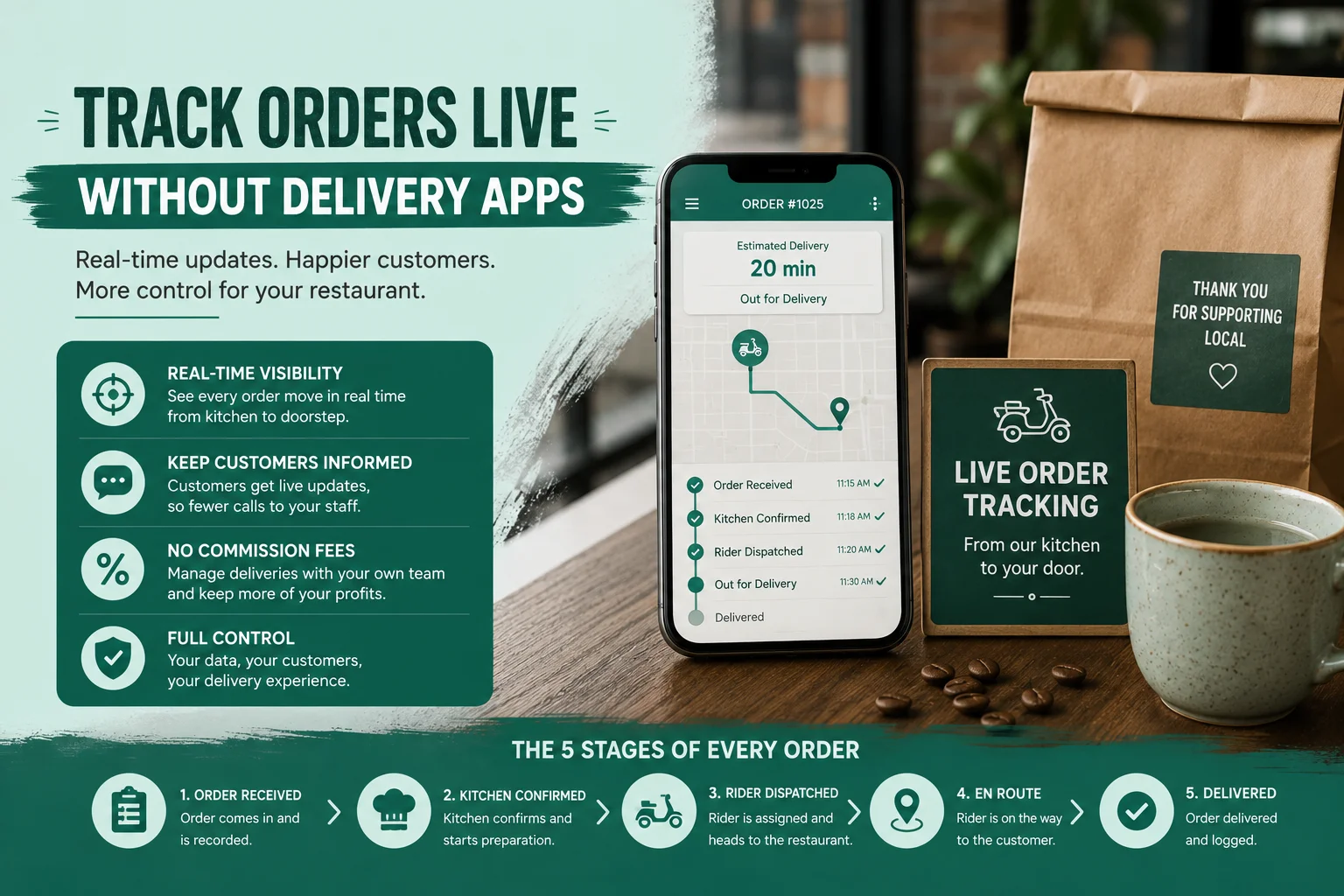
Quick Answer: Restaurants track orders in real time by using their own rider app instead of a delivery platform. Each order passes through five stages: received, kitchen confirmed, rider dispatched, out for delivery, and delivered. The status updates instantly at every step, giving both staff and customers real-time delivery tracking for restaurants without relying on a third party.
The Problem With Relying on Third-Party Delivery Platforms
Third-party apps control the data. You don't.
You can't see where your rider actually is. You can't see the real reason an order got delayed. Your customer service team is left guessing, because the tracking screen and the GPS data both belong to someone else's app.
This makes proper delivery management difficult. Every time a customer asks about their order status, your staff has to open a separate app just to find a basic answer.
Commission fees stack on top of this. Many restaurants pay 20% to 30% per order just to get access to tracking they don't even own. This is one of the biggest reasons restaurant owners look for ways to reduce third-party delivery commission in the first place.
Switching to an in-house delivery management system for restaurants removes both problems at once. You get full control over rider tracking, order status updates, and customer communication, without paying a cut of every sale to a third-party platform.
What Real-Time Order Tracking Actually Means
Real-time order tracking means your kitchen, your rider, your manager, and your customer can all see exactly where an order stands, at any moment.
Not a rough guess. Not "it's on the way." An actual status update, refreshed the second something changes.
This is different from basic order tracking, where a customer sees one static message from checkout to delivery. Live tracking updates automatically at every stage, so nobody has to ask twice.
This matters most during peak hours. A Friday night rush produces dozens of overlapping orders, and without a clear tracking dashboard, staff quickly lose track of which order is cooking, which one is out for delivery, and which customer is already calling.
Restaurants that maintain accurate order visibility make fewer mistakes and run noticeably smoother shifts, even during the busiest hours.
How to Track Food Delivery Without a Third-Party App
You can run this whole process in-house, using your own team and your own tools. No commission cuts, no third-party app controlling your data, and no waiting on someone else's system to tell you where an order stands. This is what most people mean when they search for restaurant delivery software without commission.
A Rider App That Belongs to Your Restaurant
Instead of routing deliveries through an outside platform, your own riders log into an app built for your restaurant. They see the order, the address, and the route. Nothing else.
Their location streams to your team the moment they leave. You follow the delivery step by step, the same way you'd want your customer to.
Curious what this actually looks like on the ground, from the second an order comes in to the second it lands on the doorstep? This live order tracking system lays out every stage in detail.
The Five Stages Every Order Passes Through:
A well-run order tracking process moves every order through five clear checkpoints, so nothing gets lost in the middle. Each stage gives your team and your customer a clear picture of exactly where things stand.
- Order received
- Kitchen confirmed
- Rider dispatched
- En route
- Delivered and logged
1. Order received
The moment a customer places an order, it lands directly on your system. No missed calls, no manual entry, no guessing whether it went through. This first checkpoint confirms the order has entered your restaurant's workflow.
2. Kitchen confirmed
Your kitchen staff confirm the order and start preparing it. This checkpoint tells everyone, including the customer, that the order is officially in progress. It also gives your kitchen a clear queue, so nothing gets prepared out of order.
3. Rider dispatched
A rider is assigned and picks up the order. This is where delivery tracking actually begins, and the rider's location starts updating live. From this point on, both your team and the customer can follow the delivery in real time.
4. Out for delivery
The rider is on the way, and the system shows a live location along with an estimated arrival time. This is usually the stage customers check the most. Accurate ETA tracking here is what cuts down "where is my order" calls the most.
5. Delivered and logged
The order reaches the customer, and the system logs the delivery with a timestamp and proof of delivery. This closes the order and keeps a clean record for future reference. That record also becomes useful data for reviewing delivery performance later.
Each checkpoint carries its own timestamp. If an order sits too long at any single stage, the system flags it automatically, before the customer has to call and ask.
Why Order Tracking Builds Customer Trust
People don't call because they're impatient. They call because they're unsure.
Give them a clear map and a real arrival time, and most of those calls stop happening on their own. Restaurants running their own tracking report up to 40% fewer status-check calls during busy shifts. This is one of the fastest ways restaurants avoid delivery app commission while still keeping customers just as informed, if not more, than a third-party app would.
A photo taken at the door, timestamped and logged, settles most disputes before they start. No "I never got it," no back-and-forth.
What Your Delivery Tracking Data Can Do for the Rest of Your Restaurant
A delivered order isn't the end of the story. Every order carries useful information, and once you start capturing it properly, that data can improve far more than just your delivery process.
If you're reading this, chances are you're already tracking orders but not doing much with the data afterward. That's the gap most restaurants miss, and it's costing you repeat business without you even realizing it.
Here's exactly what that order data can do once you put it to work.
Building a Full Picture of Every Customer
Once you know who orders often and what they usually pick, that history shouldn't disappear the moment the order is delivered.
Most restaurants lose this information the second an order closes. The next time that same customer orders, staff start from zero, with no memory of past preferences, allergies, or complaints.
Keeping it in one place, tied to the same person every time they order again, is exactly what a customer relationship management tool does. It turns scattered orders into one clear customer profile, so your team already knows who they're dealing with before the phone even rings.
Bringing Back Customers Who Went Quiet
Not every customer needs a discount to come back. Some just need a reminder that you're still there.
If you've ever wondered why regular customers suddenly stop ordering without any complaint, this is usually why: nobody reached out, so they quietly switched to someone who did.
Someone who ordered weekly and suddenly stopped is exactly who automated marketing tools are built to reach, without you writing a single message by hand. This kind of customer retention almost always costs less than chasing brand-new orders through ads.
Giving Tables the Same Visibility as Orders
Delivery isn't the only part of your restaurant where "where do things stand right now" matters.
The same confusion that happens with a missing delivery also happens at the front desk, double-booked tables, forgotten reservations, and walk-ins nobody accounted for.
A table booking system gives your front desk that same clear view for walk-ins, bookings, and no-shows, so your dining room runs with the same order and control as your delivery side.
One Place Where Every Order Meets
Delivery, pickup, and dine-in shouldn't run on three different screens, especially when your staff are already stretched thin during a rush.
Restaurants that juggle separate systems for each order type usually end up with the same problem: someone checks one screen, misses an order on another, and a customer waits far longer than they should.
Pulling all three into a single view is exactly what a unified order management system is designed to do, so nothing gets missed no matter how an order comes in.
Rewarding the Customers Who Keep Coming Back
A good delivery experience earns you a second order. What earns a tenth one is something else entirely.
Price and speed only go so far. Customers stay loyal to restaurants that make them feel recognized, not just served.
That's the job of a customer rewards program, built to turn one-time buyers into regulars who choose you over the competition without thinking twice.
Reading What the Numbers Are Telling You
Delivery times, peak hours, repeat rate, and order accuracy don't mean much if nobody ever looks at them.
Most restaurant owners can feel when something's off, slower nights, more complaints, fewer repeat orders, but without real numbers, it's guesswork. That's an expensive way to run a business.
Turning that raw activity into decisions you can act on is where performance insights come in, helping you spot what's working and fix what isn't before it costs you customers.
Getting Started With In-House Order Tracking
Next time that phone rings with a "where's my order" call, the fix isn't a bigger delivery app subscription. It's a system you actually own, one that shows every order, every rider, and every customer, as it happens.
The shift from third-party platforms to in-house tracking doesn't happen overnight, and it doesn't need to. Most restaurants start with delivery tracking first, since that's where the commission fees and customer complaints hurt the most. Once your team gets comfortable with the five-stage tracking flow, extending that same visibility to pickup and dine-in orders becomes a natural next step.
Restaurants that make this switch usually notice three things within the first month:
- Fewer status-check calls, since customers can already see where their order stands
- Faster staff response during peak hours, because nobody's checking multiple apps to find an answer
- A clearer picture of what's actually happening across delivery, pickup, and dine-in, data that used to disappear the moment an order closed
None of this requires replacing your entire operation overnight. It requires one decision: stop renting visibility into your own orders, and start owning it.
FAQs
Do I need a third-party delivery app to offer real-time tracking?
No. A restaurant can run its own tracking system through a dedicated rider app, giving full visibility without paying commission to an outside platform.
How does GPS tracking work for restaurant riders?
Once a rider is dispatched, their phone's location streams to the manager's dashboard. The arrival time updates continuously based on the rider's actual position and current traffic.
What is proof of delivery, and why does it matter?
Proof of delivery is a timestamped, geotagged photo captured by the rider at drop-off. It protects the restaurant from false "never arrived" claims and gives customers confirmation their order is complete.
Does real-time tracking work for pickup and dine-in orders too?
Yes. A proper tracking system covers delivery, pickup, and dine-in on one dashboard, so managers see every order type in a single view.
Is in-house order tracking GDPR compliant?
Yes, when built correctly. Rider location data should only be processed during active delivery, with tracking stopping the moment proof of delivery is submitted.
What is the best way to track restaurant deliveries without paying commission?
The most reliable way is running a dedicated rider app in-house, so location updates, ETAs, and proof of delivery all stay within your own system instead of a third-party platform.
How can restaurants avoid delivery app commission entirely?
By replacing third-party delivery platforms with an in-house rider app and order management system, restaurants keep full ownership of tracking, customer data, and delivery costs, without paying a percentage of every order to an outside company.