
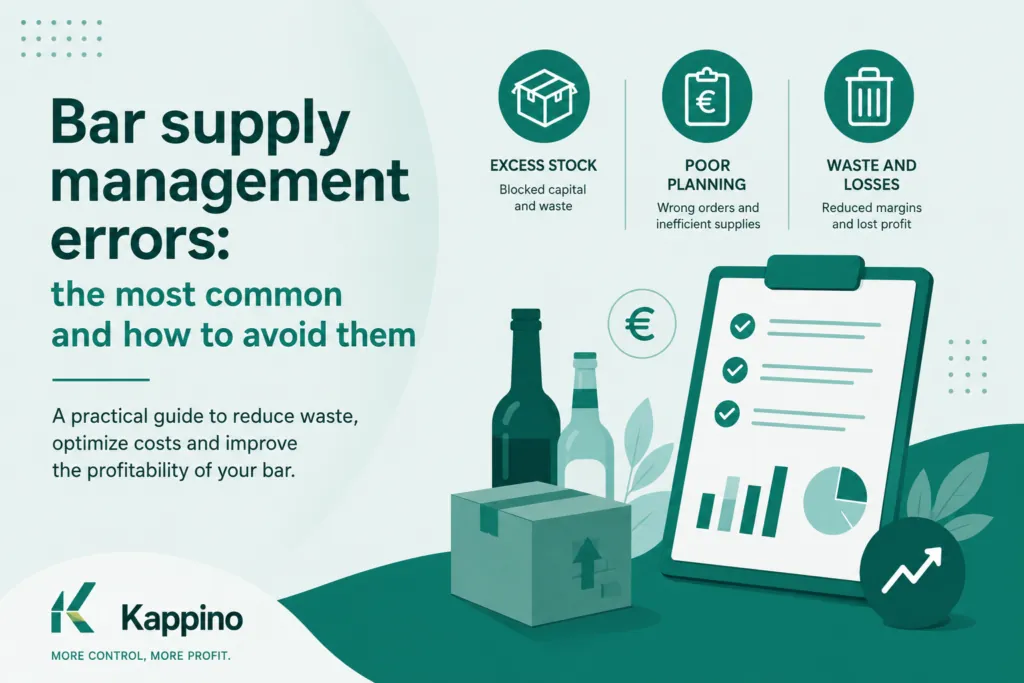
Ordering from memory, no minimum levels, untracked waste: the most common mistakes in managing your bar’s supplies, and how to stop losing money on them.
In this article
How many times have you ordered something “because it looked like it had run out”? Think of the last time you rang your supplier in a hurry because the milk was about to run out right in the middle of Saturday breakfast. Or the croissants that end up in the bin every Monday because you bought too many on Friday. Or that case of mineral water that sat in a corner for weeks and you didn’t even remember you had.
None of this looks like a disaster. But add these small losses up over twelve months and you’re talking about a real amount leaving your margin every year, quietly and steadily.
The problem isn’t you, and it isn’t your staff. It’s that hardly any bar has a clear method for keeping its supplies under control. People go by eye, by habit, by what they “usually get”. In this article we look at the most common operational mistakes in managing a bar’s supplies, what they really cost, and how to build a simple system — with supplier management and inventory management — that works even when you’re rushed off your feet.
Losses on a bar’s supplies rarely come from one big mistake. They come from small everyday inefficiencies: orders made from memory, no minimum level set per product, fresh products bought in excess, and no record of what gets thrown away. Even a simple control system, applied consistently, helps you win that margin back.
How much you’re really losing every month
If you’ve never calculated the cost of goods sold in your bar, you’re probably working blind on one of your biggest costs. The formula is simple:
Cost of goods sold = opening stock + purchases for the period − closing stock
In a well-run bar, this number should be between 25% and 30% of revenue. If you’re above that and don’t know why, you’re almost certainly losing margin on supplies without realising it. Not on one item, but on many small items nobody has ever added up.
The trickiest part is that these losses never show up as a line in the profit and loss account. They hide everywhere: in milk bought in excess, in coffee drunk by staff without being recorded, in bottles that disappear between shifts, in products ordered in a panic because they seemed to be running out. None of these events, on its own, seems serious. Together, they’re a structural problem.
Want to see your real stock, not the one in your head?
With Kappino’s management software every sale updates your stock in real time, so you always know what you really have behind the bar and in the storeroom, without counting it by hand.
The 4 operational mistakes almost every bar makes
1. Ordering from memory instead of from data
The most common method in independent bars is also the riskiest: you look at the bar, remember what ran short in the last few days, and call the supplier. It works as long as you always have the same people on shift and the bar doesn’t grow. But memory is a poor tool for managing supplies, because it doesn’t account for weekly swings, the weather, local events or menu changes. Without written data, every order is a guess. And guesses cost money.
2. Treating every product the same way
Fresh milk and a bottle of rum can’t have the same supply cycle. Milk turns over every day, expires in a few days, and if it runs out at 8 in the morning you lose breakfast. Rum can sit in storage for months without anyone thinking about it. Managing both with the same logic means having too much of one and too little of the other, almost every time.
3. Having no minimum levels for any product
The minimum level is the quantity below which you need to reorder. It sounds obvious. But how many bars have written it down even for their 5 or 6 most critical products? Hardly any. The result is that every reorder decision depends on who’s in that day, how stressed they are, and how well they remember what was ordered last week. An inconsistent system by definition.
4. Not tracking what gets thrown away
When you throw away unsold croissants at the end of the day, pour out expired milk or bin dough you didn’t use, are you recording that loss anywhere? Almost never. Yet that difference between what you bought and what you sold has a name: shrinkage, and it can be a sizeable share of what you buy each month. If you don’t measure what you lose, you can’t reduce it.
Shrinkage doesn’t always come from staff behaving badly. In most bars the main cause is simply a lack of tracking: a coffee offered to a supplier, a soft drink drunk during the shift, a badly measured portion. Without a way to record it, all of this evaporates into your margin without a trace.
Check: does your bar manage its supplies well?
Tick the situations you recognise in your bar. The more you tick, the more there is to work on.
- I order supplies by calling the supplier from memory, without a record of usage
- I don’t have a written minimum level for any product in the bar
- I throw away fresh products every week without recording how much
- I’ve made at least one emergency restock in the last month
- I don’t know my exact cost of goods sold as a percentage of revenue
- There are products in storage I haven’t sold for more than two weeks
Which products to watch first
You don’t need to monitor everything the same way. Start with the products with the biggest financial impact or the highest risk of waste. Put 70% of your attention on the 20% of supplies that weigh most on your margin.
| Category | Priority | Why it matters |
|---|---|---|
| Milk and dairy | High | Fast turnover, short shelf life, direct impact on morning breakfast |
| Coffee beans or pods | High | Main source of revenue, steady use that varies with the season |
| Fresh daily products | High | Expire daily, very high risk of waste if the order is even slightly too big |
| Draught beer | Medium | Expensive kegs, use varies across the week, storage issues |
| Bottled soft drinks and juices | Medium | Long shelf life but take up space; easy to build up too much stock without noticing |
| Spirits and liqueurs | Medium | High value per bottle, slow turnover, risk of tying up capital for nothing |
| Disposables | Low | Long shelf life, low risk of waste: just watch when to reorder |
How to build a method that holds up under pressure
You don’t need a complicated system. You need a system, whatever it is, as long as it’s applied consistently. Even the simplest written log works better than memory, as long as everyone on your team knows how to use it.
Do a first real count of what you have
Before anything else, count everything you have right now: behind the bar, in the fridge, in the pantry, in reserve. This is your starting point. From here on you can measure real usage instead of estimating it.
Record every delivery and everything you throw away
Every order that arrives gets written down with its quantities. Every product you don’t sell and throw away gets noted, even just in a notebook. After two or three weeks you already have real data on your usage, not estimates.
Work out the average daily usage of your key products
With 14–21 days of data, you can work out how many litres of milk you use on average per day, how many kilos of coffee per week, how many croissants Monday to Friday and how many at the weekend. These numbers are the basis for everything else.
Set minimum levels for critical products
For every fast-moving product, write down the quantity below which you need to reorder. This level must be high enough to cover the supplier’s delivery time, plus a safety margin. Once it’s written down, it applies to every shift, not just to you.
Review the numbers once a month
Usage changes with the seasons, with promotions, with what happens in the neighbourhood. Figures worked out in January don’t hold in July. A thirty-minute monthly review keeps the system up to date without much effort.
In bars that use a tool that updates stock with every sale, the first two steps become automatic. Every product sold reduces the quantities in real time, without anyone having to write anything down. The result is that you always have up-to-date data without adding work for your staff.
How to work out the right minimum stock for your bar
The formula is simple, but the result varies a lot from bar to bar. It depends on how often your supplier delivers, how much demand varies across the week, and how much stock you can afford to hold.
Minimum stock = average daily usage × supplier lead time in days × safety factor (1.2–1.3)
If your bar uses an average of 8 litres of milk a day and the supplier comes every two days, your minimum stock is at least 16 litres, plus a 20–25% buffer for variations. So about 19–20 litres. Dropping below that means you risk running dry before the next order.
- Measure usage over at least 14–21 consecutive days, not from your impression of last month
- Always use the worst case for the supplier’s lead time, not the average: delays always happen at the worst moment
- For fresh products, think about a maximum level too, not just a minimum: the risk is buying too much, not too little
- Remember the days your supplier is closed. If they don’t deliver on Monday, your stock on Saturday evening has to last until Tuesday morning
A bar that uses 6 kg of coffee a week and gets a delivery every 7 days should always have at least 8–9 kg in stock. If on Wednesday morning there are 4 kg left, it’s already in the risk zone. Not necessarily a crisis, but the alarm threshold has already been crossed without anyone noticing.
No more minimum levels from memory and emergency restocks
With Kappino you set the minimum level for each product just once, and you get an alert before anything actually runs out: no more panic orders on Saturday morning.
Frequently asked questions about bar supplies and stock
The formula is: opening stock plus purchases for the period minus closing stock. In a well-run bar this figure shouldn’t go above 25–30% of revenue. If you’re above that without a clear reason, there’s almost always a supply problem: untracked waste, over-ordering or selling prices too low for your costs.
It depends on the type of product. Fresh items such as croissants and pastries should be checked every day. Milk and coffee need checking two or three times a week. For beer and drinks, once a week is enough. For spirits and long-life products, a monthly check is sufficient.
Minimum stock is the quantity below which you need to reorder. Safety stock is an extra buffer that protects you when the supplier is late or demand suddenly rises. In a bar, safety stock should cover at least 2–3 days of average usage for the most critical products.
First of all, order based on real usage over the last few days, not from a few weeks ago. Then use first in, first out: what arrived first gets used first. Check every morning before opening what is about to expire. And write down what you throw away every day: after a week of data, you already know where the losses are concentrated.
Yes. A paper log or a spreadsheet works well if it’s applied consistently. The limits become clear when you have several staff shifts, when volume grows, or when you want automatic alerts before something runs out. At that point, a system that connects sales with available stock saves time and reduces human error.
See how Kappino can support your bar
Modern management software for your bar or café’s POS, inventory, customers, staff, analytics and marketing, all in one platform.