

A cafe coffee shop can sell 200 cups a day and still lose money. Sounds strange, right? But if you run one, you already know it happens more often than you'd think.
Your milk goes bad before you use it. Pastries sit unsold at closing time. Syrups run low right when your morning rush hits. These small things quietly drain your profits every single day, and you might not even notice until you check the numbers.
This is where coffee shop inventory tracking comes in. It's not just about counting stock on a shelf. It's about knowing exactly what you have, using it the right way, and ordering more before you ever run out.
In this guide, you'll learn simple ways to cut waste, keep your recipes consistent, and set the right par levels. You'll know exactly when to reorder, so you never run low at the wrong time.
By the end, you'll run your shop smoothly. No more wasted money. No more turning customers away because you ran out of oat milk.
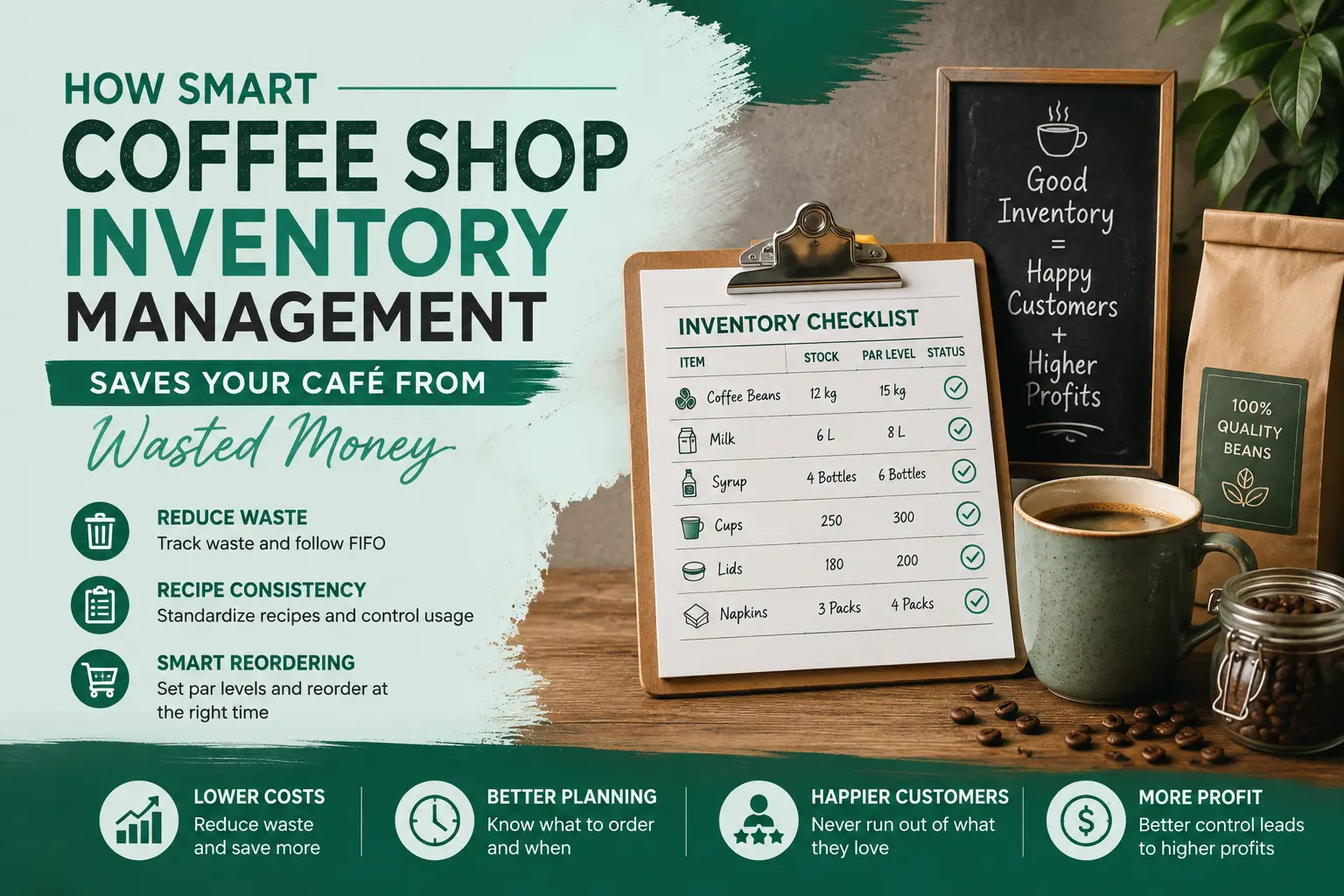
Quick Answer: Coffee shop inventory management means tracking what you buy, use, and sell. This way, you always know what's in stock. It comes down to three things. You reduce waste with FIFO and waste logs. You standardize your recipes so usage stays predictable. And you set par levels so you reorder at the right time, not too early, not too late.
What Is Coffee Shop Inventory Management and Why It Matters
You run a coffee shop. Every day, you're using beans, milk, syrups, and cups. Cafe inventory management is simply the process of tracking all of that.
It means knowing what you have, what you're using, and when to reorder before you run out.
In simple terms, it means keeping a close eye on every item that comes into your shop and goes out through your drinks. That includes your beans, milk, syrups, cups, and even your cleaning supplies. Without this, you're basically running your shop on guesswork.
It sounds simple, but it's not just a back-of-house task. It affects your profits, your menu, and how smooth your rush hours run.
Picture your busiest Saturday. If you don't know how much milk you use, you can't plan for it. You either overorder and waste money, or underorder and turn customers away. That's exactly what good coffee shop stock control fixes.
Here's a question worth asking yourself. Are you still tracking all of this in your head, or on scattered notebooks and spreadsheets? Most coffee shop owners are surprised at how much time and money they save the moment they switch to real coffee shop management software built specifically for cafés like theirs.
Everything here works together. Your recipes decide your usage. Your usage decides your reorders. Miss one piece, and the whole system starts to wobble.
The Real Cost of Poor Coffee Shop Stock Control
Poor stock control doesn't announce itself. It quietly drains your profits until you check your numbers and wonder where the money went.
Wasted ingredients push your coffee shop food cost percentage higher. Running out of your best-selling syrup during a rush sends customers to the café down the street. Your coffee shop cost of goods sold keeps shifting for no clear reason. Your staff ends up guessing instead of serving customers.
You're not alone in this either. According to Eurostat estimates, restaurants and food services account for 9.2 percent of total food waste across the EU, proof that this is an industry-wide problem, not just something happening in your shop.
None of this is hard to fix once you know what to track.
Inventory Categories Every Cafe Coffee Shop Should Track
Not every item needs the same attention. Splitting your stock into categories makes coffee shop inventory tracking easier.
| Category | Examples | Count Frequency |
|---|---|---|
| Core ingredients | Beans, milk, syrups | Daily |
| Consumables | Cups, lids, napkins | Weekly |
| Retail stock | Bagged beans, merchandise | Weekly or biweekly |
| Operational supplies | Cleaning products, sanitizer | Monthly |
Core ingredients spoil fast. They also drive most of your cost of goods sold, so they need the closest attention.
Consumables and retail stock don't need daily checks. Just don't skip operational supplies for too long, running out at the wrong time can shut down service.
Group your stock this way. It makes waste tracking, recipe costing, and reordering much easier.
Tracking categories by hand works fine when you're small. But as your shop grows, keeping up with a spreadsheet gets harder. This is usually when coffee shop owners start looking for an easier way to track your coffee shop stock instead of updating rows by hand every day.
How Cafe Coffee Shop Waste Management Helps You Stop Losing Money
You work hard every day to keep your coffee shop running. But if you're not tracking waste, you're probably losing more money than you think.
It doesn't happen all at once. It's spilled milk here, unsold pastries there. By month's end, it adds up fast. Coffee shop waste tracking fixes this, and it's easier than you think.
How to Reduce Food Waste in a Coffee Shop
Where is most of your waste coming from? Milk going bad? Pastries left over at closing? Once you know the source, cutting coffee shop food waste gets a lot easier.
Order smaller, more frequent batches for perishables. Match your orders to actual sales, since a slow Monday doesn't need Saturday's stock. Turn day-old pastries into a bundle deal instead of the trash. Train your team to use older items first.
None of this needs fancy tools. Just attention and a habit of checking your stock regularly.
FIFO for Coffee Shops: The Simple Fix Most Owners Skip
When new stock arrives, does your team place it in front of the old stock or behind it? If it's in front, you're losing money without realizing it.
FIFO for coffee shops stands for first in, first out. Use your oldest stock before the new one. For milk, cream, and pastries, this matters a lot since they don't last long.
Setting it up is simple. Place new stock behind older stock. Label everything with the date it arrived. Make sure every staff member follows this, not just one person.
This single habit is one of the easiest ways to reduce coffee shop waste, and it costs you nothing.
Tracking Coffee Shop Inventory Waste Without Extra Tools
You don't need expensive software to start tracking coffee shop inventory waste. A notebook or a shared spreadsheet works just fine when you're getting started.
Here's what to do. Every time you throw something away, write it down. What it was, how much it cost, and why it happened. Do this for two weeks straight, and you'll start seeing patterns you never noticed before.
Maybe your oat milk goes bad every single Monday. Maybe your pastries get overordered every weekday without fail. Once you spot the pattern, you can fix your ordering before the waste happens again.
Now, imagine catching all of this automatically, without writing a single thing down. That's exactly what coffee shop sales analytics does for you. It tracks your waste patterns, your usage trends, and your reorder timing in the background, so you can spend less time logging numbers and more time running your shop.
This habit also sets you up for the next step, setting accurate par levels, since you'll know exactly how much stock you actually use.
Setting Coffee Shop Par Levels to Stop Guessing on Reorders
Running out of oat milk during your morning rush isn't bad luck. It's a coffee shop reorder points problem, and it's one of the easiest things to fix once you know what to look for.
Coffee shop par levels take the guesswork out of reordering completely.
What Are Par Levels and Why Your Coffee Shop Needs Them
A par level is the amount of stock you want on hand between deliveries. It's not a guess, it's a number based on what you actually use.
Say you use 8 gallons of whole milk a day, and your supplier delivers every two days. Your par level would be around 20 gallons, enough to cover two days plus a small buffer for a busy weekend or a late delivery.
Set par levels for your top items first, beans, milk, syrups, and best-selling pastries. This gives you a clear number to reorder against, instead of eyeballing the shelf.
Your reorder point matters too. That's the exact stock level that tells you it's time to place an order, based on how long your supplier takes to deliver.
Signs Your Coffee Shop Reordering System Needs Fixing
Watch for these signs if you're not sure your coffee shop stock reordering process is working. You're constantly running out of the same one or two items. You're throwing away stock you clearly overordered. Your team places emergency orders more than once a month. Your costs shift up and down for no clear reason.
If this sounds familiar, your par levels probably don't match your real usage. That often traces back to inconsistent recipes or waste that's never been tracked properly. It also often traces back to orders being logged by hand at the counter. Pairing your par levels with proper POS software for cafés closes that gap almost instantly.
Fix those first, and your reordering system falls into place a lot faster than you'd expect.
Recipe Standardization: The Missing Piece in Coffee Shop Inventory Control
You count your stock. You track your beans. And the numbers still don't match up.
The problem might not be your counting. It might be your recipes. Coffee shop recipe standardization is one of the most overlooked parts of running a café, and fixing it changes everything.
Why Consistent Recipes Mean Accurate Coffee Shop Inventory
Without standard recipes, one barista pours syrup by eye while another measures it exactly. Multiply that across hundreds of drinks a day, and your inventory numbers stop making sense.
Coffee shop recipe consistency is what your inventory accuracy actually depends on. When every drink uses the same amount of beans, milk, and syrup, you can actually predict your usage.
Without it, you'll deal with counts that never match reality, confusing variance reports, and par levels that keep shifting for no reason.
The fix is simple: a recipe card for every drink, with exact measurements. It also makes training new staff faster, since there's no guesswork involved.
A standard cappuccino uses about 18 grams of beans. A 1kg bag gives you roughly 55 drinks. If your team isn't consistent with the dose, that number becomes useless, and so does your reorder planning.
How Portion Control Impacts Coffee Shop Costs
Coffee shop portion control might sound small, but it hits your cost of goods sold directly. A heavier pour here, an extra pump there, it adds up fast across hundreds of drinks a day.
If your recipe calls for one shot of syrup and your team pours one and a half, you're using 50% more than planned. That means faster stockouts, more frequent reorders, and rising food costs with no clear explanation.
Get your portion control right, and you get predictable ingredient costs, accurate reorder planning, and protected coffee shop profit margins on your best-selling drinks.
Use jiggers and pump counters. Keep exact amounts on every recipe card. Check in with your team now and then to make sure everyone's following the same process.
Once your recipes are consistent, everything else gets easier. Your counts make sense. Your par levels stay accurate. Your reordering finally reflects what you're actually using.
How Waste, Recipes, and Reordering Work Together in One System
Most guides treat waste, recipes, and reordering as three separate problems. They're not.
Consistent recipes give you accurate usage data. Accurate usage data lets you set correct par levels. Correct par levels mean you order the right amount, and that means less waste.
Fix one piece, and the other two get easier on their own. Fix your recipes, and your reordering starts making sense. Track your waste, and your par levels finally match reality.
This is why coffee shop inventory management works best as one connected system, not three separate tasks handled by different people who never talk to each other.
Once you see it this way, managing your coffee shop inventory system stops feeling like guesswork. It becomes a simple loop you can trust, day after day.
Final Thoughts
Coffee shop inventory management comes down to three things working together: less waste, consistent recipes, and smart reordering. Get these right, and your shop runs on real numbers instead of guesswork.
Start small. Pick one part, maybe a simple waste log or a recipe card for your top three drinks, and build from there. The rest will fall into place faster than you expect.
Frequently Asked Questions
What is coffee shop inventory management?
Coffee shop inventory management is the process of tracking what you buy, use, and sell, from coffee beans and milk to cups and syrups. It helps you avoid running out of stock, reduce waste, and control your food costs.
How often should a coffee shop count inventory?
Core ingredients like beans and milk should be counted daily since they spoil fast. Consumables like cups and napkins can be checked weekly. Retail items need a weekly or biweekly count, and operational supplies like cleaning products only need a monthly check.
What is a par level in a coffee shop?
A par level is the amount of stock you keep on hand between deliveries. It's based on your actual daily usage plus a small buffer, so you never run out before your next order arrives.
How does FIFO help reduce waste in a coffee shop?
FIFO means using your oldest stock before new stock. Since milk, cream, and pastries spoil quickly, placing new deliveries behind older stock keeps ingredients from expiring on the shelf.
Why do recipes matter for coffee shop inventory accuracy?
Inconsistent pours and portions throw off your usage data. When every drink uses the same amount of beans, milk, and syrup, your inventory counts and par levels stay accurate instead of constantly shifting.
What is a good cost of goods sold (COGS) for a coffee shop?
A healthy COGS for most coffee shops falls between 25 and 35 percent of revenue. If it's higher, it usually points to over-ordering, waste, inconsistent recipes, or pricing that's too low.