

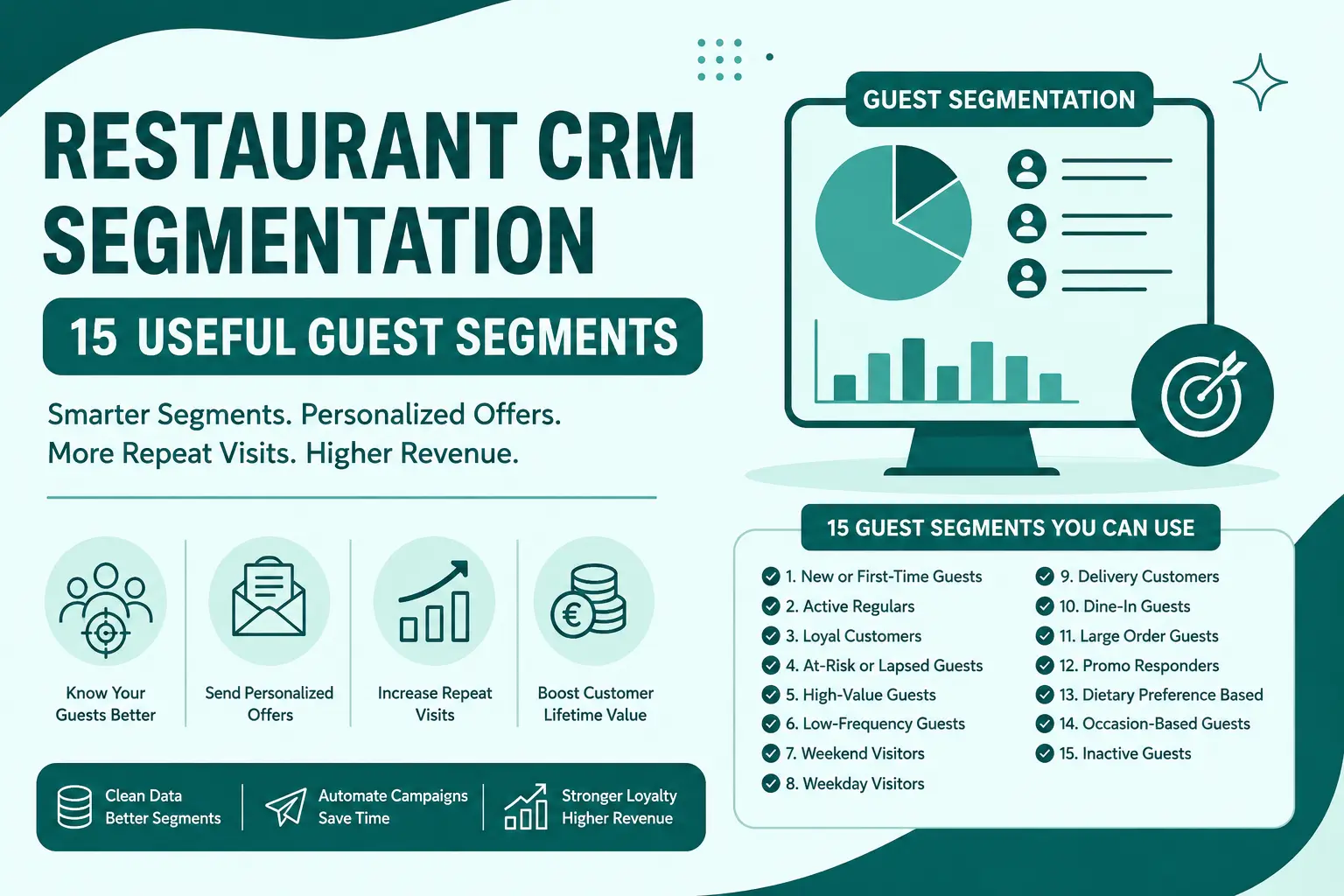
Are you still sending the same promotion to a first-time visitor and your most loyal regular? If so, your restaurant marketing automation isn't working as hard as it could. Every guest in your restaurant customer database behaves differently, and treating them the same way means lower open rates, weaker retention, and missed revenue. Restaurant CRM segmentation solves this by grouping guests based on real behavior, such as order history, visit channel, and customer lifetime value. This guide walks you through 15 useful guest segments you can start using today to build smarter, more personalized campaigns.
Quick Answer: Restaurant CRM segmentation is the process of grouping restaurant guests into smaller categories based on real behavior, such as visit frequency, average spend, dietary preferences, and order type. Instead of sending the same message to every guest, restaurants use these segments to send personalized offers that improve retention, repeat visits, and customer lifetime value.
What Is Restaurant CRM Segmentation?
Restaurant CRM segmentation means splitting your guest database into smaller, meaningful groups based on how people actually behave. Instead of treating every guest the same, you group them by things like visit frequency, average spend, dietary preferences, or how they order.
Think of it like this: a guest who visits every Friday night for cocktails has nothing in common with a family that only stops in for Sunday brunch. Sending them the same offer wastes your time and their attention.
How Customer Segmentation for Restaurants Actually Works
It starts with your restaurant customer database. Every reservation, every order, every loyalty signup adds a small piece of information to a guest's profile. Once you have enough data points, patterns start to show up on their own.
Your job isn't to guess who your best guests are. It's to let the data tell you, then build guest profile management around it so your team can act on it.
Why Guest Profile Management Matters Here
A segment is only as good as the profile behind it. If your guest data is scattered across your POS, your reservation system, and a spreadsheet nobody updates, your segments will be shaky at best.
A clean, centralized guest profile pulls together contact details, order history, visit frequency, and preferences into one place. That's what good restaurant customer database software is built to do, and it's the foundation everything else in this guide is built on.
Why Restaurant CRM Segmentation Improves Retention and Revenue
Here's a number worth remembering: returning guests typically spend around 67% more than new ones. That single stat explains why segmentation matters so much.
Getting a brand-new guest through your door is expensive. Paid ads, delivery app promotions, and discounts all cost money. Getting an existing guest to come back a second or third time costs almost nothing in comparison, especially when you're using targeted email and SMS campaigns instead of guessing.
Customer Lifetime Value and Repeat Visits
Customer lifetime value, or CLV, is simply how much a guest is worth to you over the time they keep coming back. A guest who visits monthly for three years is worth far more than someone who visits once and disappears.
Segmentation helps you protect and grow that number. When you know who your active regulars are, you can treat them differently than someone walking through your door for the first time.
How Segmentation Supports Restaurant Marketing Automation
Once your segments are built, tools that automate targeted campaigns do the heavy lifting. A new guest automatically gets a thank-you message. A lapsed regular automatically gets a "we miss you" note. Nobody on your team has to remember to send anything manually.
This is where segmentation stops being a nice idea and starts saving you real time every single week.
15 Useful Guest Segments for Your Restaurant CRM
Here are the 15 segments worth building first. You don't need all of them on day one, but each one gives you a clear, actionable way to talk to a specific group of guests.
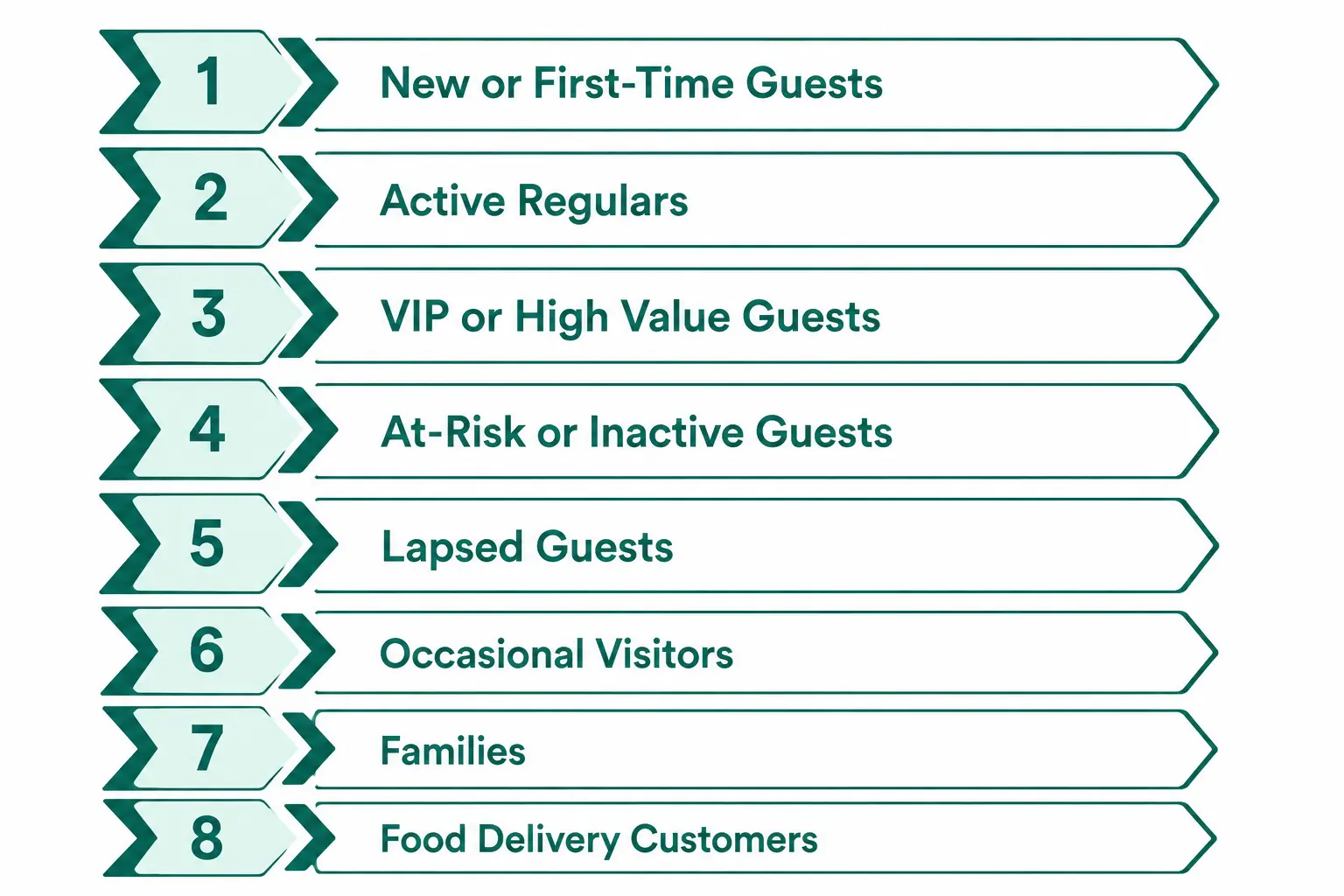
1. New or First-Time Guests
These are guests who've visited once, recently, and haven't been back yet. This is your most important segment because the decision to return usually happens within days of that first visit. Getting this right in your restaurant customer database sets the tone for the entire guest relationship.
Action: Send a simple thank-you message within 24 hours as part of your restaurant marketing automation. A quick note mentioning the dish they ordered performs far better than a generic "come back soon."
2. Active Regulars
Guests who've visited three or more times in the last six months fall into this segment. They already like you, so don't hit them with discounts. Reward them instead and track them closely in your restaurant customer database.
Action: Give early access to a new menu or invite them to a tasting event. Protect this segment; it's the backbone of your customer lifetime value.
3. Lapsed or At-Risk Regulars
These are guests who used to visit often but haven't shown up in 60 days or more. This is one of the highest-value segments in restaurant CRM segmentation because these people already know and like your food, which makes them prime candidates for customer retention efforts.
Action: Send a "we miss you" message with a small, genuine incentive through targeted email and SMS campaigns. Skip the heavy discount language; a personal tone works better here.
4. Top-Spending or VIP Guests
This is your top 10% of guests by spend. They fund a big share of your revenue and drive a large share of your customer lifetime value, so they deserve more than an automated email.
Action: A handwritten note, a personal check-in from the owner, or early access to reservations goes a long way with this group. This is where guest profile management really pays off.
5. Birthday and Anniversary Guests
Special-occasion diners are easy to spot once birthdays and anniversaries are captured at signup or reservation, and they belong in every well-built restaurant customer database.
Action: Send a personalized offer two to three weeks before the date, not on the day itself, using your restaurant marketing automation. A free dessert invitation tends to outperform a flat discount by a wide margin.
6. Daypart Diners (Brunch-Only, Dinner-Only, Lunch-Only)
Some guests only ever show up for one part of the day. Grouping by daypart is a simple form of customer segmentation for restaurants that lets you fill your slowest shifts with the right message.
Action: If Tuesday dinners run slow, target your dinner-only segment with a specific, timely offer instead of a generic blast to everyone in your restaurant customer database.
7. Delivery-Only Guests
These guests order from you regularly but have never actually walked through your door. They're often ignored in restaurant CRM segmentation, which is a missed opportunity for customer retention.
Action: Invite them to dine in for the exact dish they already order online. This single message, backed by solid guest behavior analytics, tends to convert surprisingly well.
8. Large-Party or Group Bookers
Guests who consistently book for six or more people behave differently than solo diners or couples, and they're worth their own tag in your restaurant customer database.
Action: Send them info about group menus, private dining options, or off-peak booking incentives through targeted email and SMS campaigns that make large parties easier for your kitchen to handle.
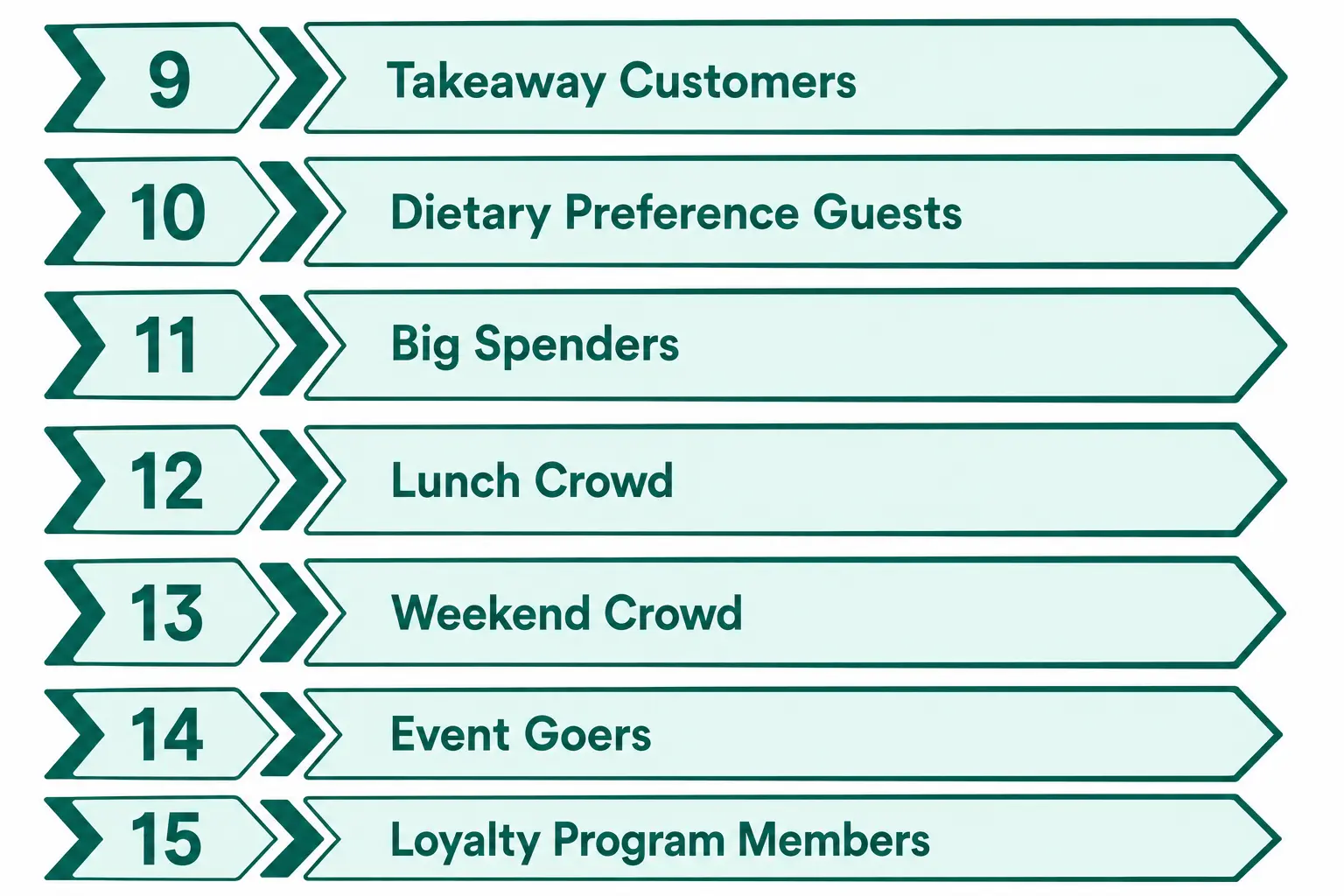
9. Dietary Preference or Allergy-Based Segments
Guests who consistently order vegetarian, vegan, or gluten-free dishes fall naturally into this group once you start tracking diner preferences in your guest profile management system.
Action: Notify them when relevant new menu items launch. It shows you're paying attention, and it keeps them ordering with confidence.
10. Loyalty Program Tier Segments
If you run a restaurant loyalty program with tiers, each tier is really its own segment with its own expectations, and it's a natural extension of your broader restaurant CRM segmentation strategy.
Action: Tailor messaging by tier. Entry-level members need a nudge to keep visiting; top-tier members expect recognition and perks, not another coupon.
11. Location or Geography-Based Guests
Guests who live or work near a specific location behave differently than guests who drive across town for you. This is a useful layer of customer segmentation for restaurants with more than one branch.
Action: Use this segment for location-specific news like new hours, a nearby event, or a grand opening at a second location.
12. Order-Type Segments (Dine-In, Takeaway, Catering)
How someone orders says a lot about how they'll respond to a campaign. Reviewing order history segmentation from your restaurant customer database makes it easy to tell dine-in, takeaway, and catering guests apart. A catering client isn't going to care about a lunch special.
Action: Keep messaging channel-specific. Catering guests want event-related offers; dine-in guests respond better to experience-driven ones.
13. High Cancellation or No-Show Risk Guests
Some guests book often but cancel or no-show more than others. This pattern is easy to miss without proper guest behavior analytics, but it's costly to your bottom line.
Action: Send a friendly confirmation reminder closer to the reservation time using your no-show reduction tools, or require a smaller deposit for repeat no-shows.
14. Feedback-Based Segments (Promoters vs. Detractors)
Guests who leave great reviews and guests who complain both deserve their own segment in your restaurant customer database, just for very different reasons.
Action: Ask happy guests to refer friends. Reach out personally to guests who had a bad experience; a thoughtful recovery message often brings them back and protects their customer lifetime value.
15. Occasion or Event-Driven Guests
These are guests who show up around specific events like holidays, game days, or seasonal menus, but not necessarily any other time. Tracking this in your restaurant customer database helps you plan ahead instead of reacting late.
Action: Build a seasonal messaging calendar around this segment using your restaurant marketing automation so you're not guessing when to reach out.
How to Build These Segments Using RFM Segmentation for Restaurants
If 15 segments feel like a lot to start with, RFM segmentation gives you a simple framework to build from.
Segmenting by Recency, Frequency, and Monetary Value
RFM stands for recency, frequency, and monetary value. In plain terms: how recently did they visit, how often do they visit, and how much do they spend?
Score guests on these three factors, and most of the 15 segments above start forming naturally. It's one of the fastest ways to turn a messy guest list into usable groups.
Combining POS Integration CRM Data with Guest Behavior Analytics
Your point-of-sale system already tracks most of what you need. A POS integration CRM setup pulls that order history, spend data, and visit timestamps directly into guest profiles without manual work.
Pair that with basic guest behavior analytics, and your segments update themselves as new orders come in, instead of going stale after a month.
Best Practices for Restaurant Customer Database Software
Good segmentation depends on good data hygiene, and that starts with choosing the right restaurant CRM software to house it. The best platforms don't just store guest data, they actively keep it clean by flagging duplicate entries and syncing updates across your POS, reservation system, and loyalty program in real time. Without that kind of automation, even the most well-planned segmentation strategy slowly falls apart as records go stale and guest profiles drift out of sync.
Here's how to keep things running smoothly.
Keeping Guest Data Clean and Centralized
Duplicate profiles and outdated contact info quietly wreck segmentation accuracy. Set a habit of merging duplicate guests and updating preferences whenever they change.
One clean guest profile beats five messy, half-updated ones every time.
Automating Targeted Email and SMS Campaigns by Segment
Once your segments exist, automation keeps them working without extra effort. Set up triggered targeted email and SMS campaigns for your highest-value segments first, like new guests and lapsed regulars, then expand from there.
Common Mistakes in Restaurant CRM Segmentation
A few mistakes show up again and again, even with good intentions.
Over-Segmenting Your Restaurant Customer Database
More segments don't automatically mean better marketing. If you're not actually sending relevant messages to a segment every month, it's not helping you. Start with six to eight segments you'll actually use, then grow from there.
Ignoring Customer Retention Restaurant Metrics
Segmentation without tracking results is just guesswork with extra steps. Keep an eye on repeat visit rate, redemption rate by segment, and customer retention restaurant metrics so you know what's actually working.
Turning Guest Data Into Repeat Visits
Restaurant CRM segmentation isn't about collecting more data for the sake of it. It's about understanding who your guests are and speaking to them like individuals instead of a mailing list.
Start small. Pick three or four segments from this list, whichever ones match a real gap in your marketing right now, and build from there. The guests who feel recognized are the ones who keep coming back.
FAQs
What is the best segmentation model for restaurants?
RFM segmentation, based on recency, frequency, and spend, is the easiest starting point for most restaurants. It's simple to set up and covers a large share of your marketing needs on its own.
How many guest segments should a restaurant use?
Start with six to eight core segments, like new guests, active regulars, lapsed regulars, and top spenders. Add more only once you're consistently using the ones you already have.
What tools support restaurant CRM segmentation?
Any restaurant customer database software that connects to your POS and reservation system can support segmentation. The key feature to look for is automatic data capture, so profiles update without manual entry.
How long does it take to see results from restaurant CRM segmentation?
Simple automations like a first-visit thank-you or birthday offer usually show results within 30 days. Segments focused on customer retention, like lapsed regulars, take 60 to 90 days to prove out. Bigger wins, like a rising customer lifetime value, build over 6 to 12 months as your restaurant customer database matures.
Is guest data privacy a concern when segmenting restaurant customers?
Yes, since segmentation often involves dietary details, birthdays, and spending habits. Good restaurant customer database software lets guests view their data, request corrections, and opt out anytime. If GDPR or CCPA applies to you, make sure your guest profile management system supports consent tracking and deletion requests.